Today, Wednesday 28th May, saw the informal hearing of the planning appeal relating to the garden room at Church Cottage in Parwich: the Peak District National Park Authority seeking to enforce a solid roadside wall on the scheme and the appellants wishing to retain it as built.
The change from Aldern House to a more local venue (Fenny Bentley School) was successful, as some dozen local residents attended. Despite this, we still think that the Memorial Hall, in Parwich itself, would have been more suitable.
The Planning Inspector presiding was Katie Peerless, a chartered architect. It had been originally arranged for a specialist ‘enforcement’ inspector to hear the case, but at the appellants’ request he was replaced by an architect, as both the appellants and the Authority were arguing on design grounds. The meeting opened with the Inspector summarising her understanding of the written representations.

Photoshop mock-up of the double wall the PDNPA wish to enforce
(the Inspector asked the Officers to confirm that plans for this solution had not been formally considered by any Planning Committee nor been the subject of any public consultation.)
Lawrence Raynor, Senior Enforcement Officer and John Sewell, Historic Buildings Officer representing the PDNPA, argued that though they liked the garden side of the building, they felt the horizontal run of windows on the road side were an inharmonious element in the streetscape, that largely blank roadside elevations were a feature of Parwich, and that as it is an extension to the cottage the windows conflicted with the single-aspect nature of the building. John Sewell stated that the Authority had no objections to a solid wall giving the cottage the appearance of having being significantly extended. Those attending were however a little bemused by his unexpected introduction at this late stage of an alternative flat roofed design option.
Lynette Coyne and Richard Tresidder, the appellants, were represented by Les Sparks, English Heritage Commissioner and former CABE Commissioner, who was involved in setting up CABE’s design review forums. Les Sparks argued that the solid roadside wall conflicted with the open nature of the village and destroyed the character of this small two bedroom cottage by over-extending it, that the six inch thick rubble wall with lime mortar matching the existing stone work proposed by the Authority was not practical, that the windows preserved the view through the building, and that local opinion was almost unanimously in favour of retaining the structure as built.

The garden room as built
(photograph taken by Lawrence Raynor, PDNPA, 06/09/07)
Some nine or ten interested parties also spoke, including local residents, all in favour of the structure as built and against the Authority’s proposal of a solid wall. Comments included the following:
- Blank or near blank roadside elevations occur in approximately 5% of the pre-1900 buildings in the conservation area, but they are very much a minority.
- The recent rejection of an application to extend Station Road Farm by the Authority on the grounds that it would be an over extension was raised.
- Modern design that differs to but fits in with the parent building is very much acceptable.
- The community particularly values the openness of the village which we see as its most important characteristic.
- The garden room as built is not perceived as an extension to the cottage, rather a distinct enclosed space.
- These widows provided additional light at night, from the kitchen windows inside, on what is a dark stretch of lane.
- The government’s increasing commitment to local consultation was raised, with Parwich’s strong self-aware community being emphasised, and evinced by such as our new village website (parwich.org).
- That form should follow function, which a solid wall would disguise.
The hearing adjourned to the site (with some of the members of the public also attending) and after walking all round the structure and listening to further representation from all, the Inspector closed by saying we would be informed of her decision within seven weeks. The general consensus of those attending was that the Inspector had ensured a very fair hearing where all opinions were heard equally, and that both sides had ample opportunity to respond.
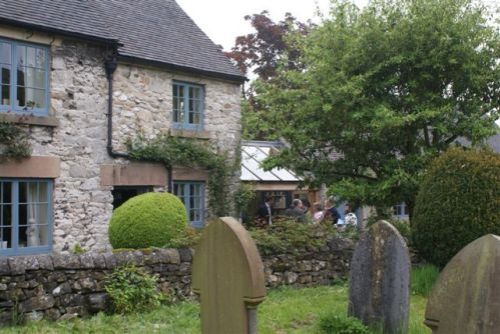
The Hearing adjourned to Church Cottage
(photographs, courtesy of John Fuller-Sessions, taken while the main parties examined the view of the garden room from inside the kitchen)

This post was up-dated 29thMay 2008 with the addition of some more of the public-attending’s comments and the final two photographs.


 PARWICH.ORG
I attended the appeal as a friend of Richard and Lynette, from Nottingham. I must say, how wonderful it was to see them supported in their endeavour. Also, it was so refreshing to see that a fresh, contemporary design which compliments its older surroundings is welcomed by local residents and indeed favoured over the pastiche, clumsy and ill-conceived alternative sought by the planners. Good luck to you all!
Mark, I hope neither the puppies nor their mum had suffered from your absence.
We have been away all week but were desperate to hear how Lynette & Richard got on, thank you to the “blog” for giving such a comprehensive update. We are keeping our fingers crossed for you that someone will finally see sense. We love the appearance of your garden room.
Lynette, you were always so artistic, the garden room and stone buildings are wonderful and remind me of the stone church on shore road, hope all is well with you and keep up the good work. Brad