JF-S asks, “Which bug is this, walking on water?”
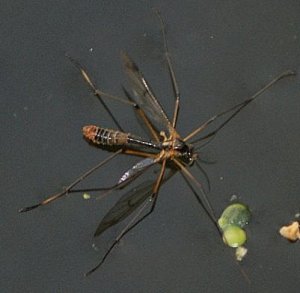
Walking on water.
Tuesday April 21, 2009 by Jane B
6 Responses
Leave a comment
Contact the blog team
Latest Comments
-


-
-
You can follow @parwichblog on Twitter, and you can also "like" us on Facebook.
-
Recent Posts
 PARWICH.ORG
I was a keen entomologist in my undergraduate days, so let’s put that rusty old knowledge to the test.
It is without doubt a member of the order Diptera (True Flies), because it has only two wings, the second pair being replaced by halteres which can be seen as small club like structures behind the wings. The halteres act like gyroscopes and help stabilise flies in flight.
Diptera include mosquitoes, gnats and midges which would fit with this aquatic image. However, I don’t think it is any of these.
If you look closely at the thorax (between the wings and halteres), you can see a dark V shape with a pale centre. Add this information to the very long legs and I’m pretty sure you have a member of the Tipulidae family which has accidentally landed on water.
I don’t think it is a water bug at all, but a Crane Fly, better know as a Daddy Longlegs.
No no no Kevin! – he means the green thing on the end of the daddy long legs leg – it’s an ameoba. (unusually it appears to be wearing a VERY tight belt, and even more strangely is floating next to a severed nose).
Bob,
If that is a severed nose, then we gardeners are in for big trouble later in the year. We no doubt have a new species of Crane Fly in Parwich – Tipula gigantica perhaps? Just imagine the size of those Leather Jackets, and what they will do to our lawns!
Our lawns!
OMG!
My expreience and Wikepedia tell me crane flies emerge in August and September.
Mike – I agree, we definitely see the vast majority of Crane Flies in the late summer, but there are spring flying species too.
Using images from the web only (which is not completely reliable), it looks to me like we have an example of T. vernalis:
http://www.naturespot.co.uk/UK%20Wildlife/Flies/TipulaVernalis.html
I have been thinking for some time about how we might use the blog as a tool to monitor our local bio-diversity. I have spoken to a friend who does this for a number of environmental groups. If anyone is interested, please let me know and I will invite her to come along and talk to us.