For those thinking about going on the History Society walk on Monday evening here are some snippets about this fascinating hill, that has been used by man for some five or so thousand years.
The name Wigber probably means Wicga’ barrow or burial mound, Wicga being an Anglo-Saxon personal name. Low, also Anglo-Saxon, literally small hill, usually also refers to a burial mound, giving the tautological Wicga’s barrow barrow.
The ridge, pictured below as seen on the skyline from Lea Hall, is immediately south of Haven Hill and east of Bradbourne Mill.
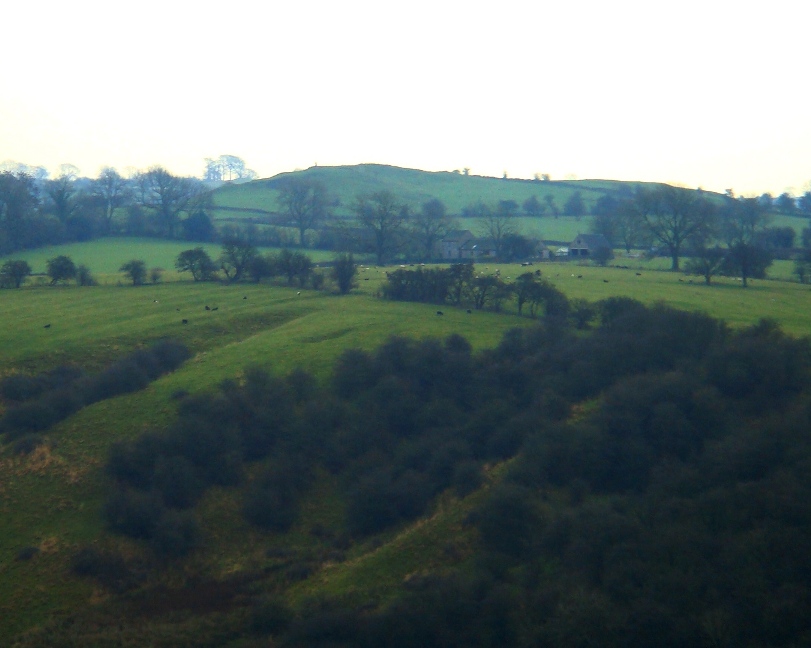
Wigber Low, though not particularly dramatic, is conspicuous from Parwich and would have been well know by local people. Before the creation of what is now the B5056, as a toll road in 1811, the main route from Parwich to Ashbourne market would have been the ancient trackway that goes up from Tissington Ford over Wigber Low and on through Kniveton.
There are signs of domestic occupation just below the summit from the Neolithic period (new stone age) onwards.
In the early Bronze Age a stone platform was built on top of the ridge. Described as an excarnation platform by archaeologists, this was used for ‘sky burials’. Also followed by some North American Indians and Tibetans, in this practice the dead body is exposed to the elements and wildlife until the flesh is cleaned from the bones, which are then taken for burial elsewhere or for other ritual uses. One can picture the crows circling the hill.
In the later Bronze Age the platform was covered in a more conventional burial mound in which cremations or bones could be inserted. It is possible that such funeral sites, as well as creating a spiritual landscape (what the much later Celtic Ancient Britons would have seen as an entrance to the ‘other world’), also served as a form of title deed: i.e. this land is ours because our ancestors dwell in this sacred place.
Little is known about the Iron Age occupants of the White Peak in the first centuries BC. Being in the boarder country between the Brigantes and Coritani, two of the tribes of Celtic Britain, it may be that here the population was fairly thin on the ground.
However, under Roman rule in the second century AD onwards, the White Peak was administered as a single unit to exploit the lead found here. At this time the archaeology indicates shepherds were living and working on this hill. Presumably they were native Britons, but also over a span of centuries Romans coins were inserted into the stones of the mound; offerings to the local gods at this hilltop temple?
It is interesting to speculate whether these coins were left by the native shepherds or by Roman visitors, either passing on the Street, the Roman road running through Brassington and Longcliffe, or coming from Lutadarum, a lost Roman ‘town’, perhaps now under Carsington Water.
After the collapse of Roman Britain, various pagan Anglo-Saxon tribes came together to create various kingdoms, the White Peak being in the northern part of Mercia. In the mid seventh century four Celtic priests from the Northumbrian monastery of Lindesfarne began the process of converting the Mercians to Christianity.
Tradition has it that one of the four, Betti, came to Wirksworth founding the church there. Also at this time a number of Anglo-Saxon graves (at least five have been identified) were inserted into the Bronze Age mound at Wigber Low. These were high status graves of members of the eorlas or warrior elite buried with their swords and valuable grave goods. Interestingly in a pre-Christian site, the grave goods, decorated with both pagan and Christian symbols, indicate that their owners were hedging their bets in matters of religion. Perhaps one of these graves belongs to Wicga after whom the hill is named.
In the Medieval period, making use of the hill top air currents to create higher temperatures Wigber Low was used for lead smelting.
In the fields around Wigber Low you can see the ridge and furrow of Medieval ploughing, but on the top of the ridge the soil is not deep enough to grew crops.
Finally, before the significant excavation of the 1970s by the University of Sheffield, there had be some archaeological exploration of the site in the nineteenth century by John Fossick Lucas of Fenny Bentley, who found a range of Anglo-Saxon metal work, including a sword.
If you want to visit Wigber Low with Parwich & District Local History Society meet at 7pm on Monday 11th May in the church hall car park at Bradbourne.


 PARWICH.ORG
Leave a comment