Thanks to Kevin S. for the following report.
NOTE: There are a couple of videos of Saturday night’s screening – complete with live organ accompaniment and audience laughter! – at the end of this post. Click “Continue Reading” to access them.
The number of cars parked around the green suggested that something very different and special was awaiting us, as we walked to St Peter’s last night to watch The Gold Rush, with organ accompaniment by Christopher Harrison. There were plenty of familiar faces sitting in the pews, but there were very many new faces too. It soon became apparent that the plethora of enthusiastic visitors had come from film clubs around Derbyshire, having heard about last night’s unique event.
The rapturous applause for Christopher’s accompaniment on organ and piano, and for the sound effects created by Martin and Arnold, were clear testament to a remarkable evening. What’s more, over £200 was raised for the church restoration fund.
The atmosphere of the darkened church, the excellent silent film and Christopher’s witty organ playing combined to magical effect. Oh, and there were great nibbles (from local cooks) and wine (courtesy of Waitrose) during the interval too.
I used to love watching the old silent movies on TV as a boy, particularly the slapstick provided by the likes of Buster Keaton and the Keystone Cops. That said, I admit to not really “getting” Charlie Chaplin, despite knowing that he was widely considered as one of the greats. Last night, I finally understood. I was struck by the number of cultural precedents that were contained within a relatively short film.
The film opens with Chaplin precariously negotiating a narrow, snow covered mountain pass, while being followed (unbeknownst to him) by a large black bear. Christopher established his theme on the organ, which echoed Chaplin’s comic gait perfectly.
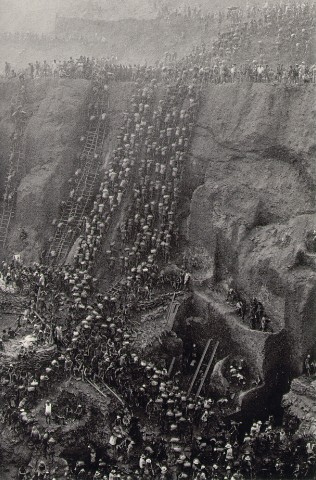
An iconic scene followed, showing hundreds of prospectors trudging through a harsh, snowy landscape in hope of finding future prosperity (as mentioned in Pheadair’s introduction). There are striking similarities between this and the famous photograph of Brazilian gold miners taken by Sebastião Salgado, sixty years later:
Much of the film then focuses on the cold, claustrophobic interior of a remote log cabin, with some hilarious set pieces involving shot guns, gale force winds (during which Chaplin seemingly invents Michael Jackson’s moonwalk), the return of the black bear, and the boiling of shoes. All this relates to the hardship and hunger experienced by the original prospectors. There are wonderful details in the Thanksgiving dinner shoe eating scene, when the hobnails become bones to be chewed, and Chaplin offers one to his companion by way of a wishbone.
In the bar-room scene, Christopher seamlessly moved from the organ to piano, to give us a wonderful honky-tonk accompaniment to the boozy ribaldry – and the introduction of the love interest.
Then it’s back to the log cabin, for one of my favourite pieces in the film: the dance of the bread rolls. I know that Pheadair included a link to it in his introduction – but I have to include it here again, because it was so wonderful.
The film reaches a literal “cliff hanger” climax, with Christopher adding to the drama to put us all on the edge of our pews by pulling out all the stops on the organ. As the log cabin teetered on the edge of a precipice, I couldn’t help but wonder if the makers of The Italian Job had also drawn inspiration from this early masterpiece.
More, please!
– Kevin S.


 PARWICH.ORG
The informative introduction on the Blog had been provided by Martin, so unfortunately I can’t claim the credit.
I was sorry to miss last night so thank you to Kevin for this write up, and I guess Martin again for the YouTube clips.
Thank you so much Kevin for your review – made the overall enjoyment of the film even greater.
The thing that amazed me about Christopher’s playing (for anyone who was not there, or who could not see him) was that it truly was improvised – he had no written music at all, and had very little time in his busy schedule to think about the music, let alone practise. It was extraordinary to watch him with his eyes fixed on his film screen watching the progress of the film, while playing the organ or piano without looking at the keys at all … it was as if it just flowed in through his eyes and out through his fingers onto the keys — no mean feat — and wonderful to watch. Thank you Christopher. Seems a shame it was a ‘one off’ and is now to be ‘lost’ ???