This email has come in from Richard Wallach of Melbourne, Australia. If you have any information, either use the comment box or email parwich@hotmail.co.uk and we will forward it on.
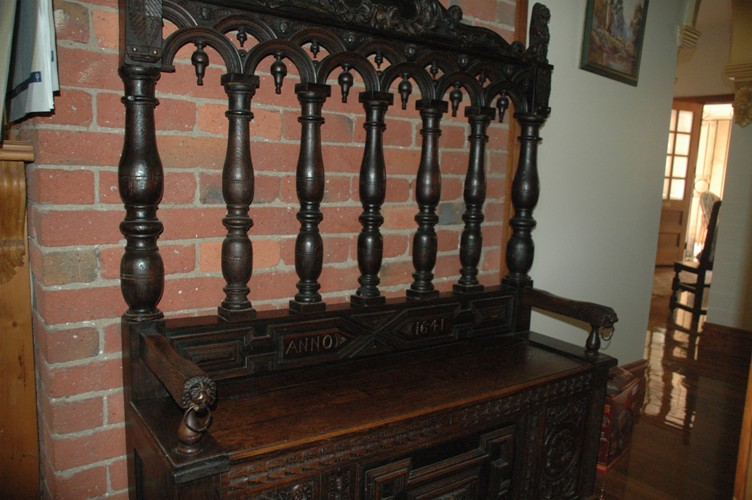
I write from my location in Australia, as I am in possession of a settle that I believe came from Alsop Hall. I have on occasion tried to make contact with people who may be able to verify the item, but to no avail. To that end, you may appreciate my reason for trying this forum.
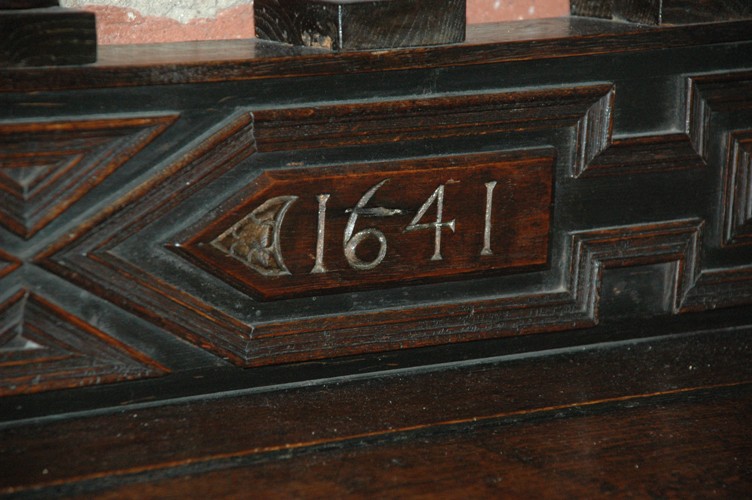
The story goes that the settle was jettisoned in the 1930s, along with other unwanted items. It was duly collected and kept rather than being destroyed, and eventually was on sold to me. I have added some images of the settle and would appreciate any help identifying it and explaining the “writing” and where possible its history.


 PARWICH.ORG
I do not have an answer but some possible clues:
In 1641 Alsop Hall was still owned by the original Alsop family, but given the number of changes in ownership and tenants between then and the 1930s the settle is unlikely to have belonged to the original family (though this is not impossible).
1641 predates the start of the English Civil War by just a year. Three younger Alsop siblings (Timothy, George and Elizabeth Alsop) left the Hall around this time for Connecticut. Elizabeth was married there in 1642/3.
Craven & Stanley’s in their ‘Derbyshire Country House’ say of the Hall:
“It was sold in the late seventeenth century by the creditors of Anthony Alsop to Robert, second son of Sir Thomas Milward. In 1711, the land was sold to Isaac Borrow of Derby and the house to the Gells of Hopton, who re-sold it 40 years later to Pole of Nottingham. It later passed through the hands of the Beresfords, the Brownsons and others before being purchased in the 1880s by Sir Samuel Allsopp, Bt., later 1st Lord Hindlip, who claimed descent from the original Alsop family. Subsequent occupants were Thomas Critchlow, John Hall, J. P., J N Heald and Edward Mark Philips (d. 1936).”
I seem to remember being told that Mr Philips’ widow did not inherit the house, but declined to move out for some years much to the annoyance of his executors, but I may have got that wrong.
QVO is unlikely to be initials for an English name, rather it looks as it ought to be Latin, could any of the following help:
Quo – Where to/What for/To which/To whom
Quae vide (qqv) – See these things
Quaere verum – Seek the truth
Qui vir odiosus! – What a bore!
Quo vadis? – Where are you going? / Whither goest thou?
Quod vide (qv) – See this thing
Quomodo vales – How are you?
Qvod vive (q.v) – Which see – a scholarly cross-reference
Obviously it is most likely to be the Latin question word Quo, and this might very speculatively be related to the two brothers and a sister of the then Lord of Alsop Hall setting of for the New World. However I also like the idea that it is an abreviation QVO for ‘Qui vir odiosus!’ or ‘What a bore!’
NB Is the settle in original condition or could the top be a later addition? The columns and top look a different oak to the rest.