Note from the blog team: Starting from today, Parwich artist Esther Tyson will be posting regular diary-style updates on her new creative project: to immortalise the seahorses of Dorset in art. In this first post, Esther gives us some personal background on the project, before explaining her forthcoming activities in more detail. Esther, it’s over to you…
1. The past.
We had been paddling along the gullies, sand squishing through our toes, small fish tickling our legs. I remember the excitement as the sand came alive and a flat fish darted from our feet. We sped up the shore to dry and get warm, then away again to searching the tide line, full of anticipation.
A stick, with a dragon head?
Once home, we rushed upstairs, knowing exactly where Dad’s Observer book of the sea shore stood and thumbed through every page until there it was – we had found our very own pipefish! It was moved out to the shed pretty quickly. Mum disposed of it when we weren’t looking; apparently it smelled bad!
Our following trip to Tridely left a stronger impression. We had been treading the gullies as usual, but the next moment was filled with fear. The ground fell away, and I was scrambling at the edge of the sand bank with nothing but clouded water beneath me. Clutching handfuls of bank, I couldn’t get out. My little sister came running; she grabbed my arm and pulled me out…
In 2005, I spent three months on an island in the Seychelles, working alongside scientists studying the indigenous magpie robin. Surrounded by the Indian Ocean and beautiful clear water, how could I not explore the reef? I decided there that I would attempt to get over this fear of deep water… maybe take swimming lessons back home.
In 2008, the Dorset Wildlife Trust announced they would be offering a diving bursary to explore UK waters. How exciting – for someone else! Or maybe it would focus my attention to break this water thing…?
Five swimming lessons on a “back to basics” course, six months and my confidence grew. Three years on, I decide to apply for the diving bursary…
2. The Project – A Personal Sense of Place: Studland, Dorset.
The aim is to produce a body of work inspired by the rare and unique seagrass meadow habitat and the weird and wonderful creatures that make it home (predominantly the two species of seahorse). With hope, this body of work will help increase awareness of the importance of this habitat.
In my research, I discovered that pipefish live in Studland’s seagrass meadows!
Studland is home to Cornish sucker, rockling, juvenile pollack, sand smelt, fifteen spined sticklebacks, snake pipefish, spiny seahorse, short-snouted seahorse, greater pipefish, broad-snouted pipefish, sea-scorpion, corkwing wrasse, shanny, tompot blenny, sandeels, dragonet, black goby, two-spot goby, sand goby, plaice, flounder, juvenile lumpsucker, worm pipefish, Nilsson’s pipefish, straight-nosed pipefish, black seabream, seabass, red mullet, grey mullet, undulate ray, sole, transparent goby, ballan wrasse & Baillon’s wrasse.
What is it about British fish? I’m already fascinated by their peculiarities!
3. Seagrass.
Seagrasses are the only truly marine flowering plants and they form a unique meadow habitat in shallow water. The species at Studland is the common eelgrass, Zostera marina.
What Does it Do?
The plants provide food for wildlfowl, such as brent goose and wigeon, and the meadows shelter a range of fish and invertebrates. Some pipefish species are almost totally restricted to seagrass meadows and the spiny seahorse is strongly associated with this habitat.
The underground stems (rhizomes) and roots of the seagrass help bind together and stabilise the seabed sediment, reducing rates of erosion – potentially important in a site like Studland.
A Rare & Unique Underwater Habitat
Globally, seagrass meadows are under threat. A recent study reported that 58% of the world’s seagrass meadows are declining, with 110km2 of seagrass disappearing every year since 1980 – the main causes being direct loss from coastal development and dredging and indirect impacts of declining water quality.
Other impacts include boating, fishing and natural impacts such as storms and disease.
Seagrass meadows appear on several lists indicating the conservation importance of this habitat. It is a UK Priority habitat, and is on the OSPAR List of Threatened and/or Declining Species and Habitats.
4. The Seahorse.
In 2004, Dorset Wildlife Trust’s Julie Hatcher spotted the first pregnant male seahorse to be recorded in British waters. At the time, seahorses had no legal protection, so the location of this sighting was kept a closely guarded secret.
Two Species Recognised
In April 2008, the list of species protected under the Wildlife and Countryside Act was finally amended and included both seahorse species known from the UK: the spiny seahorse (Hippocampus guttulatus) and the short-snouted seahorse (Hippocampus hippocampus). This is good news for seahorses in general and should remove the threat of collectors targeting known seahorse sites.
5. Seahorses in a Seagrass Meadow.
The site of the 2004 discovery could now be revealed as Studland Bay, specifically a seagrass meadow at the southern end of the beach. Repeat visits in 2008 produced many more sightings, including pregnant individuals of both species, making Studland one of the top seahorse sites in the country.
It’s not all good news, though. The sheltered conditions at Studland that allow the seagrass to prosper also make the site an attractive anchorage for visiting boats and there is a real concern that the anchoring pressure could be having a detrimental effect on the seagrass, and therefore on the seahorses.
6. Safeguarding the Seahorses
After much discussion with the wide variety of groups and individuals with an interest in Studland, a meeting held at Dorset Wildlife Trust agreed a plan of action to safeguard the future of seahorses at Studland.
This involves setting up a trial no-anchoring zone in the seagrass meadow, which will allow a properly controlled scientific study of the impact of anchoring on the seagrass; the trial replacement of a number of the permanent moorings with “eco-friendly” moorings (which don’t scour the seabed around the mooring anchor) and the development of an education and awareness programme to highlight the issues and promote “seahorse-friendly” behaviour among visitors.
7. Esther’s press release: 2011.
Dorset’s seahorses are to be immortalised in art. Fine artist Esther Tyson has been announced as the winner of the Undersea Wildlife Art Award from Dorset Wildlife Trust in association with The Society of Wildlife Artists (SWLA). The award, established in 2007, provides a bursary for an established artist to learn to dive and then to work underwater off the Dorset coast, recording the wildlife of the sea in art.
Esther, who is based in Parwich, Derbyshire and studied at the University of Wales and the Royal College of Art, applied for the award after reading about Studland’s colony of spiny and short-snouted seahorses. An accomplished artist who achieves remarkable images with an economy of masterful brushstrokes, her work was selected for the cover of the SWLA’s catalogue and poster for its annual exhibition this year.
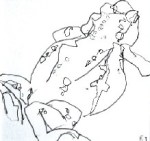
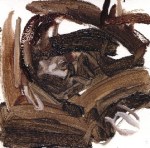

Esther said: “I intend to produce a body of work that reflects and represents my personal observations and opinions based on this rare seagrass meadow habitat and the weird and wonderful creatures that make it home. With hope, my work, giving a personal sense of this wonderful place, will help in raising awareness of the importance of this habitat.”
The award was conceived by Dorset Wildlife Trust’s Living Seas Manager, Peter Tinsley, to bring the underwater world of Dorset’s seas to wider attention, allowing more people to see its beauties and so raising awareness of the need to protect it. He said: “Few people can witness underwater wildlife first-hand and we depend on those that do to tell us about it – in stories and pictures. Esther will be spending a lot of time studying Studland’s seagrass meadows and her resulting work will bring alive a rare and inaccessible habitat, creating a unique portrait of a world that few will see directly. It will help people connect to something that is as much part of Dorset’s natural heritage as the visible landscape, but that has always seemed remote.
Esther will come to Dorset in spring 2011 to be trained in scuba diving and then to start work underwater in Studland Bay, with help from Dorset Wildlife Trust marine staff. The finished work will be exhibited in Dorset and in the SWLA’s annual exhibition in London later this year.
Heck, now I’ve gone and done it!
In her next blog post, Esther will be starting to record her day-by-day project diary.


 PARWICH.ORG
Leave a comment