Skeletons of women and children found buried during a 2 year community dig revealing crucial new evidence on Iron Age hill forts, the first discovery of its kind in Britain.
This grisly discovery, which will be of interest to many history buffs in Parwich, has been made at Fin Cop and sheds new light on Iron Age hillforts and the history of our ancient ancestors. The remains of women, babies, a toddler and a single teenage male have all been uncovered. This is the first time a selective massacre of women and children has been found on an Iron Age hillfort in Britain.
Archaeologists believe the people at Fin Cop died after the hill fort had been attacked and captured. The women and children died of flesh wounds that have left no trace on the surviving bones, and were then flung unceremoniously into the ditch at the foot of the hillfort. There are no remains of any adult males in the ditch suggesting the men at the hillfort were sold on as slaves or pressed into military service. So far only 10 metres of ditch, out of 400 metres, has been excavated and it is likely that hundreds of skeletons are still buried there.
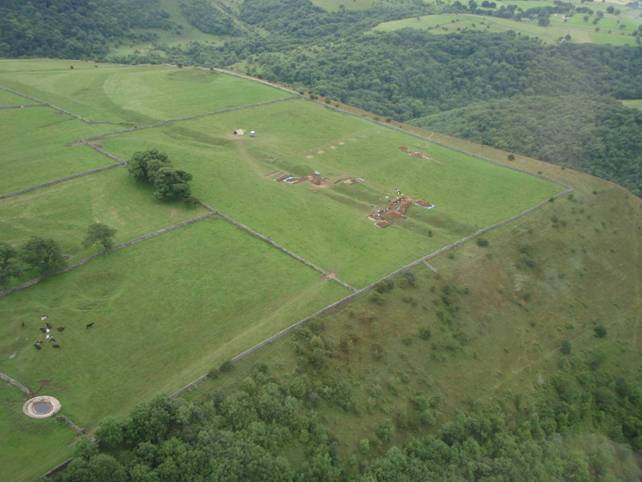
Hillforts were built to protect people. As more sophisticated and lethal weapons were used in tribal disputes and warfare during the Iron Age, these structures were built across the country as defences. They were hives of activity; a centre for trading and tribal gatherings as well as providing shelter for people and animals. Hillfort excavations help us to build a picture of how people in the Iron Age lived.

The excavations revealed the hillfort consists of a stone wall made from limestone with shaped facing stones on its outer side, a carefully laid rubble core and a rough, but substantial face at the rear. It measured 4m wide and probably stood the same high. Whether it had a timber breastwork running along the top of it remains unknown, but there was certainly sufficient width for there to have been a walkway or fighting platform on top. Outside the wall was a rock-cut ditch with a vertical inner face and flat bottom that measured 2m deep and 5m wide. A second outer wall and ditch had been started but this was never finished.
Radiocarbon dating has shown that the hillfort was built in the period 440-390 BC with the destruction of the fort and slaying of its inhabitants taking place soon afterwards. Animal bones from within the ditch showed that people kept cattle, sheep and pig as well as horses. Horses were high status animals in the Iron Age and this indicates that the local elite may have resided there. Plant remains have shown that yew, hazel and ash trees, and possibly blackthorn, grew in the vicinity of the site.
This discovery is unique as evidence for a selective massacre at a hillfort has never been found before. Hillforts are built on high ground, often on acidic soils which accelerate the decay of organic material such as bones. At Fin Cop the soil is much less acidic, as it sits on limestone geology, and this has allowed the bones to survive. It raises the question as to whether other hillforts experienced violent attacks but the evidence to prove this has not survived.
Excavations were carried out by Longstone Local History Group under the direction of Archaeological Research Services Ltd and supported by the Heritage Lottery Fund, the Peak District National Park Authority and English Heritage who, between them, provided £100,000 of funding and expertise.
Jon Humble, English Heritage Inspector of Ancient Monuments for Derbyshire, said; “This project shows, quite literally in spades, what can be achieved when professional archaeologists, community and school groups work together on an archaeological mystery – and there are many more mysteries out there in the Peak District that have yet to be solved. The Heritage Lottery Fund should be congratulated for their vision in financially supporting this hugely worthwhile project.”
The project has not just been a huge research success; it has bonded together the local community who came in their hundreds to participate in this project. Over 400 school children took part in the excavations, which were undertaken over two summer seasons in 2009 and 2010, together with over a hundred local volunteers.
The project won the British Archaeology Awards ‘Best Community Project 2010’ at a recent awards ceremony at the British Museum.


 PARWICH.ORG
i beg to differ…it was Monsal Head and indeed not Monyash
Steve, it is good to know that the blog is read properly, it is of course Monsal Dale/Head, so I have corrected the blog. Thank you