Spring is fast approaching and our winter visitors are departing, it’s time to start thinking gardens!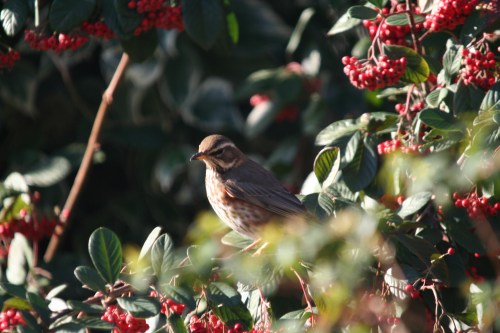
After reading Emma’s recent post about the best broad bean and tomatoes seeds to grow in Parwich I got to thinking how much gardening knowledge there is in the village and how little I know! Though I’ve successfully grown both for the last two years I was embarrassed to post a comment as the beans came as small plants labelled “Broad Beans” from Homebase and the tomatoes nicely planted up in large hanging baskets having been grown on in the big greenhouses at Wyaston Nurseries. My gardening experience seems to revolve around rotting rose blossoms, mildewy bears britches, brown spotted broad beans, non-appearing carrots and hosting slug and snail parties.
So now you know my level of gardening knowledge you will understand why I thought it would be a good idea to start a regular gardening post on the blog where we could share the pool of local knowledge with us newcomers/novice gardeners. After all what grows happily in Berkshire won’t necessarily survive in Parwich. There always seems to be people with too many seeds/plants/crops so this could be a useful sharing and swopping point. So welcome to the place where you can ask the gardening questions you were always afraid to ask!
Plant of the Month
The first regular feature is my garden plant of the month (always assuming any plants survive! ). This month it is the Galanthus – the Snowdrop. Our garden seems to be crowded with them at the moment – not planted by me I should add.
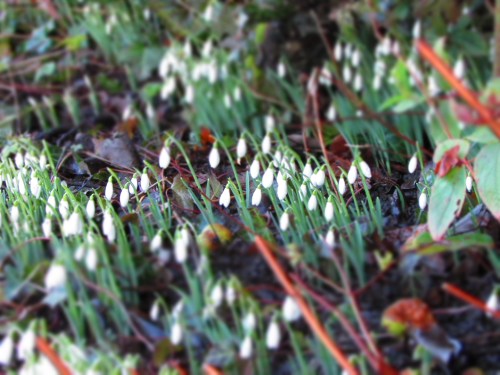
I’ve read they should be lifted and divided every 3-4 years, after flowering. We’ve been here for 3 years so I guess that’s a job for me sometime soon?
For Project of the month, Any Answers and Jobs for the garden…
Project of the Month
For my last birthday the kids bought me a small glass cloche so trying it out will be my first project of the year.
I was kindly given some farmyard manure a few months ago which I have had sitting on a raised bed for a while. I’ve now raked this over and placed my new pride and joy over it to start warming the soil. I thought I’d try a few broad beans under it ( if anyone has any spare? Cough, cough) as my contribution to furthering the broad bean village knowledge.


Stay tuned to keep track of the progress!
Any Answers?
I’m baffled…….
~ My climbing rose is covered in buds, some trying to open. What’s going on? What should I do?

~ One area of lawn is saturated. It’s like walking on a squelchy sponge. I’ve seen drier, harder ground on the Kinder Scout peat bogs. Help!
~ We grew a Magnolia last year for the first time. There were lots of buds but only one left when it came to flowering. This years there’s lots of buds again but already a few bare stalk ends are appearing. Who’s eating the buds?
Jobs around the Garden
According to our smart 2017 gardening calendar these are some of the jobs I should be carrying out in the garden at the moment…..
Pruning apples and pears
Pruning roses,honeysuckles and late flowering clematis
Preparing beds, mulching etc.
Chitting potatoes
Sowing broad beans (yay!)
Sowing tomatoes and peppers in propagators
Cleaning patios, tools, watering cans and containers
Any handy tips of other things we should be doing now?
Before anyone asks the title of the post comes from my favourite gardening joke though I fear it’s a little too rude to publish here 🙂
Until the next time….
Montys Gone


 PARWICH.ORG
If you are moving snowdrops the best time to do this is after they have flowered while there are still green leaves on the bulbs (referred to as ‘in the green’). I don’t know if it is absolutely necessary to divide snowdrops, they seem to flourish if left undivided, however it is amazing how rapidly they multiply if divided.
Also if you want to get new snow drops it is best to order them about now, so they arrive ‘in the green’ to be planted as soon as possible on delivery. Bulbs that are lifted and allowed to dry out are much less likely to take when replanted.
Having said that, some years ago an area of snowdrops in a previous garden got dug over in summer and the bulbs unintentionally scattered. It seemed like an impossible task to pick up and replant every bulb, so I just covered the area with a couple of inches of mulch, I think it was spent mushroom compost, and much to my amazement, the next year what previously had been a few patches became a carpet of white blossoms covering the whole boarder.
Problems with a boggy lawn relate to drainage. If severe you may need to think about lifting the lawn to put drainage underneath. Firstly is the water building up on your lawn rain that is failing to drain away, or ground water coming up from below?
It is worth thinking about why the water is building up, is it because the underlying ground is very clayey and there is no way for the water to drain away, or is it because the surface has become compacted and the water is struggling to penetrate into the soil.
With severe problems, it may be that you need to dig up the lawn to get drainage into the ground, however before attempting this it is worth thinking about trying to loosen up the soil structure of the top few inches of the soil. One thing you could think about now is plunging a fork well into the ground all over the area involved, though baring in mind that working on waterlogged ground may serve to further compact the soil. This shoul help drainage if the problem is soil compaction, but is only a short term fix as you are in danger of adding to the compaction by doing this.
Ultimately you need to loosen the soil structure of the lawn overall. When the ground is drier, probably not until late spring or early summer, get some coarse lawn sand and hire a motor powered hollow tining machine, one that creates lots of holes in the lawn by taking up plugs of soil. After hollow tining the lawn, rake up the plugs removed, then spread the sand across the lawn in an attempt to loosely fill the holes you have created with sand. It may also help to mix some soil and lawn fertiliser into the sand before you spread it, also if there are bare patches you could add some grass seed into the mix. This may need to be repeated over several years to fully resolve the problem.
You can also use this as an attempt to fill any dips or hollows, by spreading the sand soil mix more thickly in the hollows, though if it is a quarter of an inch thick or more, you will need to sow further grass seed on top. When doing something like this, walk on the lawn as little as possible for a couple of weeks after, to allow it time to recover.
Some good advice, thank you Peter. I think it’s clay that doesn’t drain very well. We dug a hole and it looks to be quite a deep layer.
Now I just need to get a ladder before Mrs Monty starts shouting again }:-)
Hi Monty, we have lots of beautiful snowdrops too. Early last summer I dug a few clumps up and transferred them, they appear to have transferred ok, all beautifully waving in the wind this morning.
Greetings Monty….
I have some broad bean seeds if you want to give them ago. I have 2 varieties at present – how many seeds so you want to try with?
I find that a mixture of buying plants and growing from seed is the best way to hedge your bets. Bill gets a good variety of excellent quality veg plants in every year at Leatherbritches, though I guess it’s a bit early yet….
Oh great, what varieities are they.
Thanks
Monty
They are Bunyards Exhibition and Karmazyn.
I read that it’s time to feed red currants, we have mature shrubs that have produced an excellent crop for the last few years without feed, what should I feed them with, is dried chicken manure ok?
I can let you have wet chicken manure Lynn!
On the subject of snowdrops ..about four years ago I bought about a thousand bulbs ‘in the green’ from a reknowned supplier of natural snowdrops. Spent back breaking hours planting them at the perfect depth beneath a newly planted copse of trees and the following year……only four came up. Over the next few years I took to ‘weeding out’ bulbs that were in the wrong place elsewhere in my garden and just chucked them haphazardly beneath the trees. Now I have a beautiful glade of white snowdrops. I’m sure there’s a moral there somewhere.
That must have been so disappointing. I experienced something similar with anemone blanda bulbs, I planted several hundred, having carefully matched the variety that were already growing in our garden, only to be disappointed last spring when only three actually flowered!
Is this a good time to talk about Alliums? 😦
My bears britches also tend to get mildew Monty, but I have found that cutting away some of the abundant leaves to allow the air to circulate seemed to help a bit. As an aside, you probably know how hard they are to kill and that even the tiniest bit of root grows into a huge monster so I have decided to make use of this. Last year when visiting a palace in Spain, I saw a small wood totally under planted with BB – stunning – so am now going to chop up one plant and try this myself in the hope that the weeds currently occupying the space will surrender. (Loved the title of your post and look forward to more gardening rambles)
Thank you for your comments Patti. When we moved here there was a large clump (bunch? forrest?) of BBs. They suffered badly from mildew. I dug out a few. That seemed to do the trick as the next year they were fine, as you say letting in more air. However they were awful again this year. In the end I cut out all the leaves, just leaving the flowering stems and planted some surplus Cosmos from Mrs Montys cut flower patch. That worked quite well, the BB flowers standing proud over the Cosmos.

This last Autumn I followed some of that other famous Monty’s advice and dug up the entire border to (hopefully) breathe new life into the border, splitting and rearranging plants, getting rid of couch grass, etc,etc. I tried to get rid of the BB but as you say the roots are just amazing, very deep and everywhere, so I expect they will be with us again this year. Mr Don will have a lot to answer for if I end up with the best display of weeds in the village 😦
I would say that alliums have been fine as I have several different varieties that come back faithfully every year. I did have the same disappearing act twenty years ago with about a hundred Lilium Regale. However two years ago I planted a hundred white Cassia bulbs as my blue ones have produced a splendid display for years. Now coincidentally I planted these on the other side of the wall by the snowdrop wood ( not really a wood, more a clump of trees but it sounds good) and over the winter sadly watched more and holes appearing where the bulbs were supposed to be. Mice were the culprits and they continued to decimate my planned showstopper and eventually the wall was peppered with green stalks as they attempted to drag the growing bulbs through the dry stone wall. I think about half survived. That’s the downside of living next to beautiful green fields, that and badgers digging for worms, foxes digging for badgers, pheasants pecking off new buds, creeping buttercup, dandelions and thistles blowing over the walls to list but a few. Great backdrop though!
Sorry – should have been Camassia – didn’t spot auto spelling (in) correction.