125 Years Ago
Derbyshire Advertiser and Journal 11 March 1892

Derby Daily Telegraph 14 March 1892

Could this be The Fold?
150 Years Ago
Derbyshire Advertiser and Journal 1 March 1867

Harriet Lees (nee Wood born Elkstone) was the widow of William Lees who was born in Parwich. Harriet and William were married on 26 December 1850 in St Peter’s, Parwich. In 1851 and 1861 they were living in Parwich, William being described as a farmer of 56 acres. William died 28 Nov 1864 age 41 and Harriet on 17 Feb 1867 age 44, they are buried in Parwich churchyard. Unfortunately neither the 1851 nor 1861 census tell where they were farming. Does anyone know?
225 Years Ago
Derby Mercury 2 February 1792
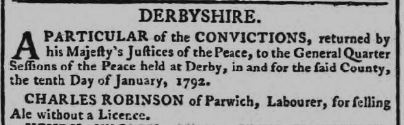
275 Years Ago
Derby Mercury 20 January 1742


 PARWICH.ORG
In the Free Library item, Mrs May was the wife of the Vicar; for much of the nineteenth century the Hall served as the Vicarage. I understand the village reading room was an upstairs room in the Hall steading, in the central part that is now the Stables Cottage. Presumably this is where this library was housed.
I was about to ask where the Free Library was probably housed, Peter. I find these posts fascinating and an interesting insight into village life as well as how news was written. We look at the past through rose-tinted spectacles and we like to think we live in a more “sensational” time, yet 19th century readers enjoyed a good courtroom drama and some of the newspaper clippings I’ve read during my own research over the years are surprisingly graphic.
If you think “fake news” is also a 21st century concept, take a look at “yellow journalism”. It peaked in the late 1800s, particularly in the US (but also here) where rival newspapers would print stories with little or no research. Scandals and “unnamed sources” were the norm. Sound familiar?
Paper was taxed throughout Queen Anna’s reign (to help pay for the war with France – see, always at war with someone!) until it was repealed in the mid-19th century. The printing of newspapers became cheaper, literacy rates improved due to education reform, and more people read newspapers, magazines, and novels, which links nicely to there being a demand for a library in Parwich in 1892.
Looking forward to the next article!
Caroline it is interesting you raise literacy, as the above advert for a house to let may be the Fold which was a private girl’s school about this time. The Fold had been the home of main line of the Parwich Swindells for several hundred years. The last Swindell to live there left it to his sister, a widowed Mrs Critchlow, who in turn left it to her daughter and son in law, Mrs & Mrs Mason. The Masons must have been quite entrepreneurial, as initially they extended the property to create a large dairy and cheese store in the mid 1800s, but shortly after that they emigrated to North America. The Masons retained Parwich links as they paid for the main east window in the new Church, the building of which was not thought of until after their emigration.
I forget the order of tenants, but the Fold was variously home to Wright Greatorix, a carter and shop keeper who also took in paying guests, a private girls school, and the Parwich Unity Club.
There were other schools in the village: the Evans family who bought the Estate in the 1830s, used the Hall as the Vicarage and set up a school initially in the Hall steading in a first floor room at the Hall end of the coach house; a house was built for the school master at the other end of the block, what is now School View; then the present school and headmaster’s house was built later. But also there had been a school at some point in Orchard Farm and in one of the pair of cottages on the Green.