The demolition of the Carbide Shed prompted me to look through the History Society’s archives to see if there was any relevant information. I found it on the following two maps:
The 1843 Tithe Map (held in the County Records Office, Matlock) shows there was a shed on the same site at that date.
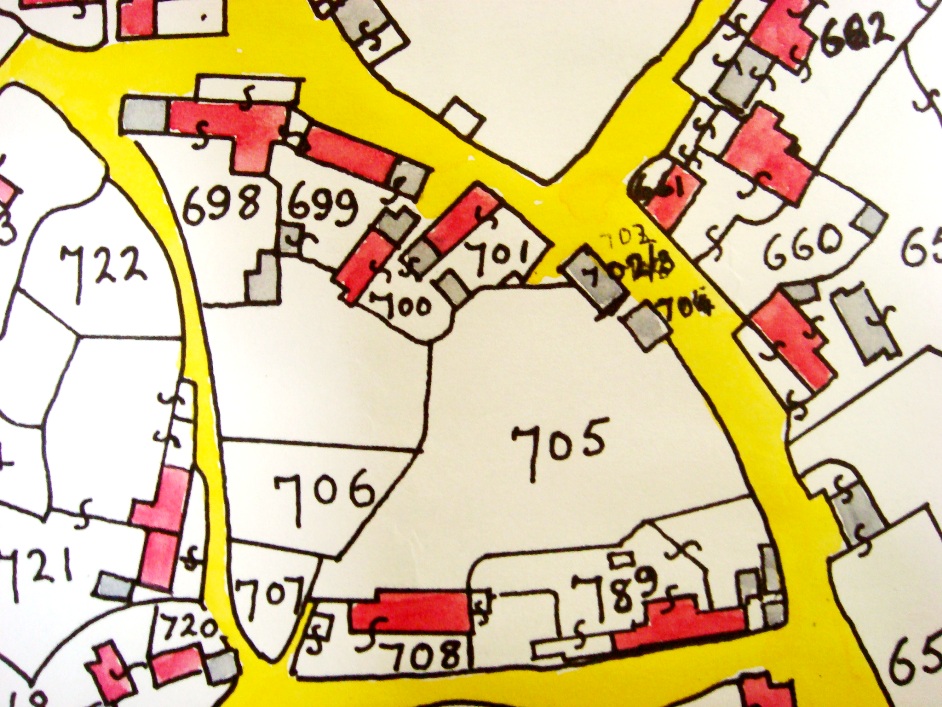
Section of the 1843 Tithe map for Parwich as copied by Brian Foden
The Memorial Hall site is plot 705, which, then belonging to William Evans Esq., is listed as pasture tenanted by Thomas Shaw, who was living in part of what is now called Shaw Lane House (plot 709, wrongly shown above as 789). Presumable having Shaws living here resulted in the name Shaw Lane.
The Carbide Shed is plot 704, which, then belonging to William Wright a saddler in Parwich, was rented by William Webster as a coal-house. William Wright lived in a house, subsequently demolished, on the site of the Professor’s house, and had his saddler’s shop on what is now the small square between the former Spa Shop and Fernlea’s cart shed. William Webster lived in part of The Square (no. 661), which also was owned by William Wright.
For interest: 701 is the former Spa Shop, 700 is Hideaway Cottage and 708 a house, demolished, on the site of the Legion. The footpath does not seem to be in existence then.
The shed is also shown on the 1915 Auction particulars for Parwich Estate when the Lewis and Curtis families planned to sell out their interest inherited some twenty years earlier from Sir William Evans.
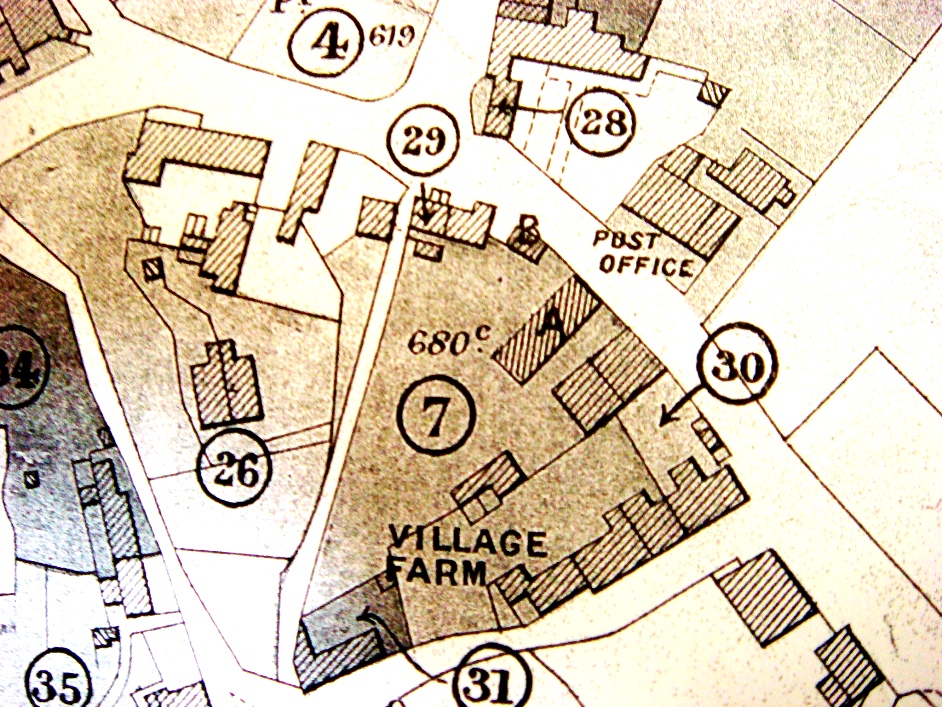
Section of the map accompanying the 1915 auction particulars for Parwich Estate
Village Farm (now Shaw Lane House), lot 7, was tenanted by Douglas Twigge with some 28 acres of associated farm land, which would have been out of the village. The buildings marked as A and B are explained as follows:
The Structure of the Building marked “A” on Plan is reserved by the Vendor from sale. The said Building is used as the Village Club Room and Institute, by whom the Rental of 10s per annum is paid to the present Tenant of the Land, and the Purchaser of this Lot will therefore be at liberty to this arrangement or regain possession of the Land by giving the necessary notice. The Building marked “B” on the Plan is a Shed, in which is situated a Plant for making Acetylene Gas, now used to supply the Institute and St. Peter’s Church, and is believed to be connected with certain Gas Pipes under the public roadway to the Gas Standards therein, to which however no supplies are at present connected. The Institute has hitherto paid a sum of £4 per annum, and the Authorities of St. Peter’s Church the sum of £3 per annum for the use of the said Plant, providing their own materials and labour for the purpose.
The Rev Claude Lewis was Vicar of Parwich and lived at the Hall, though his mother, who died in 1915, had been the co-owner of the Estate with her sister Mrs Curtis. The Rev Claude is named as the vendor of this main part of the Estate, including these lots.
I do not think that all the Estate was sold at this time, certainly the Sycamore Inn, included in the particulars was not in fact sold until 1919. The plot of the Institute (part of Lot 7) was subsequently transferred from Claude’s brother, Gerald Lewis to the ownership of the Church in 1921, and lot 30 (Shaw Lane Cottage) was sold by their sister Lucy in 1924. Gerald and Lucy lived at Hallcliffe up to the early 1920s, when they moved to Guernsey.
Interestingly the house on the Legion site, was demolished by the drawing of 1915 map and the remaining/replacement building (Lot 31) was a Butcher’s Shop with associated slaughter house and stable, for sale with vacant possession.
If you have any information on the history of the Carbide Shed or the Parwich Church Institute do contact Peter Trewhitt or the Local History Society via parwichistory@hotmail.com as we hope to have futher information in the Society’s upcoming (over due) News Quarterly.


 PARWICH.ORG
I had been told that the Parwich Institute was a relocated former military building, but am not sure how reliable this information was. After the First and Second World Wars, Nissen huts were re-used for civilian purposes, however would the military be scrapping corrugated iron buildings shortly before or even during the first year of the First World War.
Alternatively if, as the map demonstrates, it was built by November 1915, could it have come from Tin Town?
Tin Town or more properly Birchinlee was constructed to house the navvies who built the Howden and Derwent Reservoirs. Building of Birchinlee started in 1901 was completed in 1902. At its height, this temporary village of corrugated iron buildings housed nearly 1,000 people, along with shops, a school and a village hall. Within 14 years the entire village was dismantled, and the buildings sold off.
The Howden Reservoir was completed in 1912 and the Derwent in 1916. Although the timing would be tight, is it possible that Parwich Institute came from Tin Town?
See:
– http://en.wikipedia.org/wiki/Birchinlee
– http://www.telegraph.co.uk/property/3292955/A-model-of-success.html