Several escaped garden plants are a nuisance in the Peak Park, including Japanese knotweed, rhododendron and Himalayan balsam.
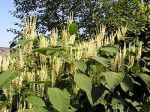 Locally there is Japanese Knotweed in Parwich churchyard which fortunately was spotted in time. Once established, Japanese knotweed is virtually indestructible. (Neither weed killer nor digging it up help. About all you can do is plant trees to hide it.) Next to the shed in the churchyard, the Parwich plant has been cut off every time it shows above ground for several years. Now, although it continues reappearing, it is looking much less vigorous.
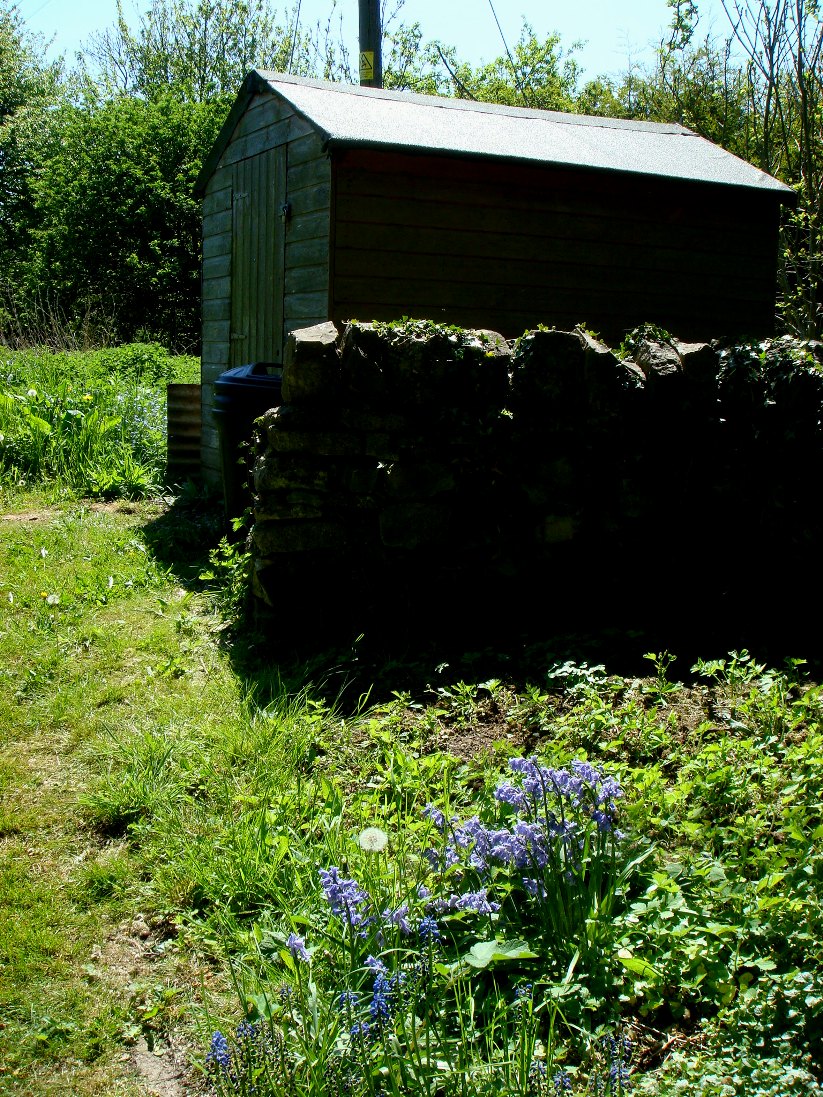
A Japanese knotweed plant keeps sending up shots just before the wall, here in Parwich churchyard. If you see any shots please snap them off.
Do you know of any other sites these plants grow in Parwich, Alsop, Ballidon or Pikehall?
The Peak Park Authority have sent a request for volunteers to help with their campaign to control Himalaya balsam that is taking over some river banks in the Park. Although it is an attractive pink flower with exploding seed pods that children love, it completely smothers the native plants.
For more on their plans to combat Himalayan balsam read the Peak Park’s full press release –
PR 677 – 21 May 2010
Act now to help stop pink invader
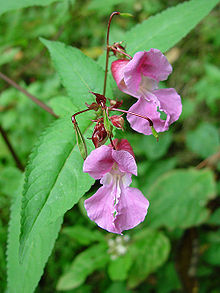 Volunteers are needed to help stop the non-native Himalayan balsam having a devastating impact along Peak District riversides.
Spreading along riverbanks, the pink-flowered invader engulfs native species and causes erosion which affects bankside wildlife.
Now the Peak District National Park Authority, the Derbyshire Wildlife Trust and Trent Rivers Trust are asking for volunteers to help pull up this year’s crop from the Derwent, Dove, Hamps and Manifold valleys.
National park ecologist Frances Horsford explained: “We need to get rid of it in July/August before it seeds. Each plant produces up to 800 seeds in pods that ‘explode’ on touch, catapulting the seed up to seven metres. In autumn it dies back leaving bare banks.
“It was introduced to gardens in the 1800s, but quickly escaped and now threatens the biodiversity of our riversides. We’d be very grateful for people’s help before it’s too late.”
The first volunteer day is Wednesday June 2 from 10am to 3pm along the River Dove, meeting at Hulme End car park. Volunteers must be over 18 and reasonably fit. They need to bring wellies, gloves, waterproofs, a packed lunch and drinks but no dogs. Booking essential on 01298 84992.
Volunteer days on the Derwent are 10am-3pm, Sunday July 11, Sat July 17 and Sunday July 25, meeting near Calver crossroads on A623, by the playing fields (opposite Peaklander Footwear). Gloves, goggles and drinks are provided, bring wellies and refreshments. Children must be with an adult, and again no dogs. Queries: 01433 631405.
For news of other volunteer days, contact Derbyshire Wildlife Trust on 01773 881188.


 PARWICH.ORG
Leave a comment