Thank you to Peter Trewhitt for providing this interview with Simon Spencer, Councillor for the Dovedale and Parwich Ward of Derbyshire Dales District Council
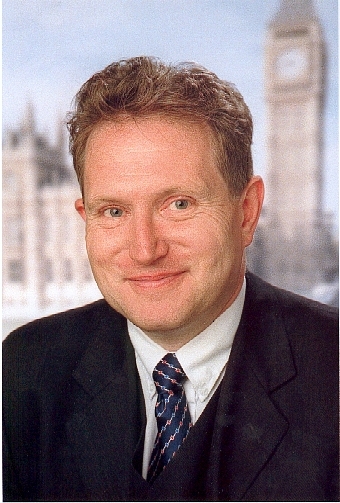
Simon Spencer should be well placed to understand our local issues. His family have lived and worked in the area for sometime, the family firm, Spencer’s Bakery of Ashbourne, having been founded in 1826. Although born in New Zealand, he came back to Ashbourne when only six months old, and has lived here ever since. Attending Osmaston Primary School, he quickly became familiar with the Parwich and Dovedale area helping his grandfather and later his uncles with their daily bread deliveries. Also his connection with Parwich included annual trips to Parwich Wakes: “It was a really good day out.”
After leaving Queen Elizabeth Grammar School, Simon worked for a while in the family firm before joining the Derbyshire Fire Service. He was a fireman for some 19 years, serving mainly in Derby itself. After his father’s retirement in 1985 he returned to run Spencer’s, which he has continued to do since.
Local government and community service have been something of a family tradition, with his grandfather having been mayor of Ashbourne. Simon has been active in politics since his early 30s in various capacities, becoming in 1999 the youngest mayor of Ashbourne (aged 39 years) since his grandfather. He became a District Councillor in 1997, first for Ashbourne and latterly for the Dovedale and Parwich Ward. In some ways he finds being Councillor for our Ward more straight forward than being a Councillor for Ashbourne, because he understands the area, but does not so often have to declare possible conflict of interests.
He has a keen interest in national politics having twice stood as a Conservative parliamentary candidate in 2001 and 2005. He continues to have ambitions to serve a Derbyshire constituency in Westminster. Indeed, after the May 1st local elections, this ambition may be a step nearer realisation. However his “passion still lies with local politics, ensuring the people of Derbyshire Dales have the best facilities and services”.
The Dovedale and Parwich Ward covers Mappleton, Fenny Bentley, Thorpe, Tissington, Eaton & Alsop, Parwich, Biggin and Hartington Nether Quarter. This means Simon is District Councillor for most of our area, excluding Ballidon that is in the Carsington Ward and parts of Pikehall that is split between some four wards. Also this means that the majority of his constituents live within the Peak District National Park, an ongoing source of frustration to Simon.
The Interview
How does the District Council work?
“Derbyshire Dales have a revised committee system rather than individuals carrying a portfolio. There are two committees ‘Community and Environment’ and ‘Partnership and Regeneration’. I first served on the Community and Environment Committee, which covers refuse collection, leisure services, environmental health, corporate management and the community award scheme. Currently I am chair of the Partnership and Regeneration Committee, which covers street cleaning, car parking, the environment, markets, housing, vulnerable people and tourism. I am perhaps in a unique position on the Council in having chaired both these committees.
The District Council’s main local priority is affordable housing. We have been successful drawing in funding from the East Midlands Housing Association (3.5 million for 2008, and 5.3 million for the two years after that). My only concern about affordable housing relates to the Peak Park Authority (see below). We need a radical approach to house our young people and cover the cost. Without affordable homes the shops, the schools and so on will go, and our communities are no longer sustainable. The main criteria for initiating developments is demonstrating need through housing needs surveys. Unfortunately this does not reflect rapid local changes in need.
Derbyshire Dales has also introduced policies to protect public houses in rural areas (this does not apply to the part of Derbyshire Dales within the National Park). It is important that systems are in place in the planning process to protect them.
Derbyshire Dales District Council has been under funded now for eight years. In real terms we have seen cuts in rate support. While doing what we can in the back office, eventually this will hit front line services. We must fulfil our statutory requirements first and it is the non-statutory services that are hit (e.g. public conveniences which are currently in the paper).”
How do you relate to the Parish Councils?
“I try to attend as many parish council meetings as possible. I attend all the open meetings in the Ward, and attend other parish council meetings when asked. Parish councils offer the grassroots perspective on any local issues from planning to the environment, to housing, to make sure the policy makers know what the area wants. A strong parish council makes my job much easier.
Parwich is a good example of a community, of a village that is empowered. The Parish Council is very well run and has a full complement of members and unlike many others meets regularly. Groups reporting to the Parish Council Open Meeting does not happen elsewhere and in my opinion is a very good thing.”
What is the role of Derbyshire County Council?
“The core priorities of the County Council are education, social services, transport and roads. I feel we have been badly let down by the County Council on road maintenance. For example on the B5056, repeatedly patching it up in various places is not sufficient to deal with the vehicles that must use the road. The County Council have a responsibility to address the road as a whole. Similarly with the A515, the route needs to be seen as a whole. I supported the raising of the bridge at Fenny Bentley over some of the more complex engineering solutions proposed, but the whole route needs to be taken into account.
The District and County Councils are now working more closely together and some services are delivered in partnership. For example tourism is overseen by a partnership arrangement including amongst others the County Council and the various district councils. Similarly supporting people, delivering services to disadvantaged groups such as the young with particular problems, the elderly, victims of domestic violence and drug and alcohol services are provided through partnership arrangements. The relative importance of different issues varies across the county as the population make up varies. County-wide partnerships mean we can draw on expertise developed in other areas.
In relation to public transport the County Council needs to ensure we get at least as good a service as they have in the north east of the County. We need a bus service that fulfils the need of the community. If the County Council are really serious, not just ticking boxes, they need to look at how it serves the needs of the local communities. In the past I have offered jobs to people from villages who have been unable to take them up because of transport problems.”
How do you find working with the Peak District National Park Authority?
“It is a problem that Peak District National Park Authority members are appointed, not elected. What some members do not realise is the Park houses a living working community. In my view it is a place where people live and work principally and a visitor centre secondly. Derbyshire Dales District Council only appoints three out of the 30 board members, although it covers the largest part of the Park. We do not get a fair crack at the whip.
Putting pressure on the Peak Park is very difficult; they are unelected and not responsible to anyone. They need to become more transparent.
The Peak Park needs to review its allocation procedure for local needs housing. If young people move away for a while to one of the neighbouring cities, they are excluded from local needs housing, there is not a mechanism that allows them to come back. Building affordable homes in the Park is difficult; trying to build low cost homes given the planning regulations is a nonsense. I have started this debate with the Peak Park.
It is frustrating for me that the majority of my area is in the Peak Park and I as an elected member have no say, except on a consultation basis, on any planning applications that come along.”
How can we meet the needs of young people?
“Addressing the needs of young people, especially in rural communities has always been an issue. Parwich does have an array of sports facilities that is almost unique for such a small community. Having said that, young people tend to want to go into the relatively urban areas, which again comes down to an appropriate transport system.
Some facilities have to be in the larger centres. Ashbourne Leisure Centre (my grandfather started the fund raising for this in the 1960s) is a great facility, but it is no use without a means of getting there.”
What are your thoughts on PARWICH.ORG?
“Parwich has a very good community spirit. I am familiar with the concept of blogs, but have not made much use of them. It is undoubtedly going to be very useful to the Parish Council and the Memorial Hall Committee.
It could also be used to promote local businesses to tourists, and may have an important role for the local school. Certainly you should do an update on school places each year.
It will be an excellent tool for a small parish council and the community to deliver local services and I think you have done a great job of it.”
Your councillor is always happy to hear from his constituents:
Mr Simon Spencer
Rose View, Roston, Ashbourne, DE6 2EH
Tel. 01335 324324
simon.spencer@derbyshiredales.gov.uk


 PARWICH.ORG
It is great to see Simon Spencer’s commitment to affordable and local needs housing. It’s the most important thing for young and not so young people in the ward.