Field barns are an important feature of the White Peak landscape that surrounds our villages. As patterns of land holdings have changed (the village farm houses serving scattered fields are now gone, replaced by larger farms with houses and farm buildings on the land being farmed) and farming methods have improved, these fine buildings have become redundant, with many falling into disrepair. Here are some of the field barns that can be seen around Parwich Hill (just these local photos by Peter T):


A new book entitled “Field Barns of the Peak District” by Sheila Haines celebrates these buildings and challenges us to find new uses for them before they are irreparable ruins. Parwich.org would welcome any further photographs of the barns in our local parishes, perhaps to created a gazetteer and photographic record of those in Parwich, Eaton & Alsop and Ballidon.
For more information on Sheila Haines’ book
Peak District NPA – Press Release ID 1065
New book celebrates disappearing Peak District field barns
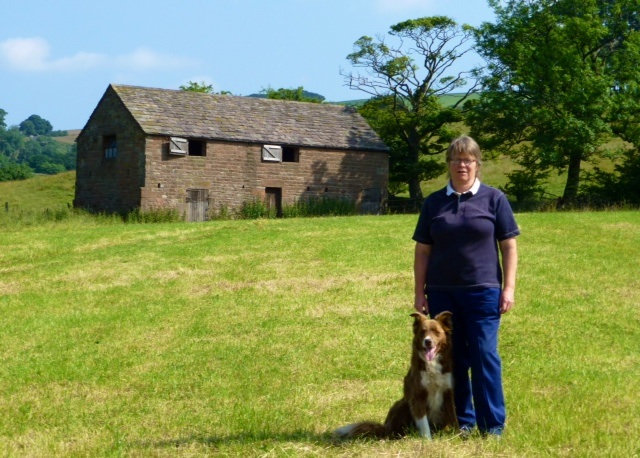
Sheila Hine, author of Field Barns of the Peak District
My father used to milk in Windy Arbour Barn; batch milking in the summer when the cows were grazing. He used to cool the milk in a small stream behind the barn, then he would take it with his horse and trap to the cheese factory at Glutton Bridge. He milked there until the late 1950s.
This farmer’s recollection from a bygone era is just one of the memories recorded in a new book, “Field Barns of the Peak District” by Sheila Hine.
Limestone and gritstone field barns are a special element of the Peak District landscape enjoyed by millions, but with changes in farming practices many of these centuries-old buildings are slowly falling into ruin. Sheila, a farmer with an interest in landscape photography, set out to capture images and memories of barns in all parts of the Peak District before it is too late.
“They sit in the landscape organically, usually made from locally sourced stone and often set in stunning scenery,” she said.
“They’re a far cry from modern agricultural buildings which although functional often sit as a scar in the landscape.”
“This book captures where we are now and celebrates field barns before many more of them are lost back to nature or recycled into another building.”
Sheila, who farms at Meerbrook in the Staffordshire Moorlands, interviewed farmers to record how individual barns were used for housing cattle, lambing, milking, winter shelter or hay storage, and what their condition is now.
The Peak District National Park Authority supported the book as field barns are a special part of the area’s heritage and landscape.
Cultural heritage manager Ken Smith said:
“Field barns help us understand how our landscape was created and managed for hundreds of years. They’re also valuable wildlife habitats – their disappearance would be an immeasurable loss on several fronts. Farmers are understandably reluctant to put money into maintaining them when there’s no immediate purpose, and consequently some are in good condition and others are ruinous.
Sheila understands farmers’ financial constraints and she highlights the problem of looking after them. Only a small number of barns can be saved by grant schemes, so it’s a question of creative thinking to bring them back into agricultural or perhaps rural crafts use. Conversion into houses isn’t the answer as most of these barns are simple structures that should remain part of the wild open landscape of the national park.
House conversions would spoil that, with a drive, utilities and all the urbanised paraphernalia of modern living. Sheila’s book celebrates the barns and their part in social history, acknowledging the sheer graft of people who built and worked in them, and I hope it inspires people to look at ways they could be utilised once more.”
Field Barns of the Peak District by Sheila Hine (ISBN 9781904546924) is available in Peak District National Park visitor centres or through the publisher Churnet Valley Books on www.leekbooks.co.uk or 01538 399033 (£16.95, UK post-free).


 PARWICH.ORG
Excellent post, on a subject I find most interesting Peter. I recognise Twodale Barn along Parwich Lane (just S of Roystone Rocks) in a couple of your pictures – a particularly fine field barn. Although just outside our home Parishes, there’s a really marvellous field barn, albeit sadly dilapidated as most are, along the SE track continuation of Reynards Lane (Hartington Town Quarter) toward Biggin Dale OS Grid: SK 13999 59150.
As to a gazetteer of these iconic buildings within our three Parishes, what a good idea! I’ll happily compile a record of those in my own Parish of Eaton and Alsop, with notes, locations (Ordnance Survey Grid coords) and photographs. I wonder whether there’s any funding available to protect them from further decay (emphatically not to turn them into dwellings or else beautify them) since they do form such an important part of our landscape here?
I popped up to Parsley Hay Cycle Centre earlier to see if I could buy a copy of Sheila Hine’s book there, but alas there were none in stock. I’ll try Bakewell PDNP Visitor Centre next.
Several years ago there was a project in Bonsal trying to preserve their field barns, but I don’t know where they got their funding. I know it is something the Peak Park Authority would support, but they are having to tighten their budget so their support is likely to be moral, contacts and information rather than financial.
The last three are in Monsdale Lane, and it may be that the middle one at the old market garden by Cuckoo Gate benefited from the Countryside Stewardship Scheme, that helped with the other improvements there.
Thank you Peter. I shall enquire further about the PDNPA’s position on field barn preservation. Ahead of reading Sheila Hine’s book, I’m guessing she has raised the subject eloquently.
I made a video earlier this year which features some field barns in our vicinity, though it was of course focused on Vaughan Williams’ music.
Anthony