
Archive for the ‘Sustainability’ Category
Merry Christmas!
Posted in Health Care, Opinion, Sustainability on Tuesday December 24, 2019| Leave a Comment »
National Allotments Week
Posted in Gardens, Sustainability on Monday August 14, 2017| 3 Comments »
Well if cats can have their day why not allotments!
The National Allotment Society is running this initiative to help protect, promote and preserve allotments. More information can be found here
At this point I should be asking, like with the cats, for pictures of your allotment. However as we don’t have any allotments that would be rather pointless! I can’t help looking at all those under-utilised sports fields and thinking would a corner of one of those be missed? So instead of pictures here’s a quick poll.
Merry Christmas!
Posted in Health Care, Opinion, Sustainability on Saturday December 24, 2016| Leave a Comment »
Update on a central recycling point in Parwich.
Posted in Environment, Local government, Parish Council, Services, Sustainability on Tuesday February 11, 2014| 1 Comment »
Somewhat belatedly here is an update on the situation re. the ‘bring’ recycling point at the Sycamore Inn. The general recycling here has now been removed.
Following a reader request we ran an on-line poll here at parwich.org on this ‘bring’ recycling point, to which some 78 individuals responded, with a large minority (45%) in favour of retaining some form of central recycling point in Parwich (click here to see our report in pdf format). This report was sent to the Parish Council, who were supportive of the need to retain some form of central recycling point in Parwich (click here to see their response posted here at parwich.org).
We also forwarded it to our District Council, Sir Richard FitzHerbert, along with a request for further discussion of what action could be taken to enable some central recycling to continue in Parwich. He passed the information on to Heidi McDougall (Head of Environmental Services) asking her to respond on his behalf. She has sent a full email (the text of her response is reproduced at the end of this post), explaining reasons why it would not be possible to retain the then existing service at the Sycamore. The District Council is strongly stating that any problems residents have must be dealt with on a house by house basis. Residents can contact the waste helpline on 01629 761122 to discuss their own particular situation.
Planning permission granted for two wind turbines at Hill Top Farm
Posted in 2012, Environment, Farming, Peak Park, Planning, Posts of Note, Sustainability on Tuesday December 11, 2012| Leave a Comment »
According to details on the PDNPA website, planning permission has been granted for two wind turbines at Hill Top Farm, each at a tower height of 24.5m, with a further 9m rotor radius. This is smaller than the originally rejected proposal, which measured 48.4m from base to blade tip. Note also that this is a time-limited consent, which expires after 25 years.
Click here to read the letter of notification, and click here for links to all the publicly available documentation.
Renewables for Businesses
Posted in Environment, Peak Park, Planning, Sustainability on Monday November 5, 2012| Leave a Comment »
| Free business workshop on renewables and climate change |
| Business people wanting to future-proof against climate change and learn about energy-saving can go along to a free half-day training workshop.
Business Peak District is holding the workshop at Beechenhill Farm, Ilam, near Ashbourne, whose environmentally-friendly farming and holiday business has just been shortlisted for a Virgin Holidays Responsible Tourism award. People who attend the workshop will learn about key steps to saving energy, installing renewable technology and how to make their businesses more resilient to climate change. (more…) |
Wind turbine proposal ‘too tall’ for national park
Posted in 2012, Environment, Farming, Peak Park, Planning, Posts of Note, Sustainability on Monday January 16, 2012| 3 Comments »
The following statement was issued today by the Peak District National Park Authority. This relates to the recent planning application for a wind turbine at Hill Top Farm. (more…)
UK Government proposed changes to solar PV Feed-in-Tariffs
Posted in 2011, Posts of Note, Sustainability on Tuesday November 1, 2011| Leave a Comment »
In August I wrote a detailed article about sustainability, giving all the renewable energy options available to us. Yesterday the government announced major new proposals to the Feed in Tariffs that will affect the cost effectiveness of PV panel.
Under the proposals, the new tariffs would apply to all new eligible solar PV installations installed on or after 12 December 2011. These installations would receive the current tariff of 43.3p before moving to the lower tariffs, 21p, on 1 April 2012.
Consumers who already receive a FIT will see their existing payments unchanged, and those with an eligibility date on or before 11 December 2011 will receive the current rate.
The table below compares typical income and savings made for an average sized solar PV system in the UK based on the Energy Saving Trust’s website.
| FIT Rates | Total annual earnings and savings with a 2.9kW system |
Simple payback (years) |
| Current – higher tariff 43.3p/kWh | £1,190 | 11 |
| Proposed – lower tariff 21p/kWh | £640 | 20 |
Please note that these proposals are currently under consultation and are therefore not final. However, the Energy Savings Trust recommend customers should use the figures in the consultation if they are planning to install after 12 December 2011.
Hill Top Farm – Wind Turbine Planning Application
Posted in Environment, Farming, Opinion, Peak Park, People, Planning, Sustainability on Tuesday September 27, 2011| Leave a Comment »
The planning application from Robert Gosling at Hill Top Farm has been registered with Peak District National Park. Application number: NP/DDD/0911/0933 Proposal: Erection of a single wind turbine and stone build plant rooms.
All the planning documents can been seen on the National Park website or by visiting the Peak Park at Bakewell.
Wind Turbine – Noise Assessment
Posted in Farming, People, Sustainability on Friday September 2, 2011| 6 Comments »
Due to concerns raised about potential noise levels in the village, we conducted a further more extensive assessment which is quite technical but does conclude that noise may only be faintly audible under rare conditions, i.e. downwind at high wind speeds.
We hope to submit a planning application within the next 10 days.
Robert Gosling, Hill Top Farm.
To access the report, please click on the photo.
Open letter to the community about the proposed wind turbine – 5th May 2011.
Proposed wind turbine for Hill Top Farm: exhibition boards & questionnaire – 17th May 2011.
Update on proposed wind turbine – 1st June 2011
Wind Turbine – Reply to questions raised – 17th June 2011
Renewable Energy and Planning
Posted in 2011, Posts of Note, Sustainability on Friday August 12, 2011| 4 Comments »
The following post covers all the different types of Renewable Energy discussed at last month’s sustainability meeting, as well as drawing together additional information and links to other official sites. There is a lot of detail included, so do use the Index to find the information that is relevant to your own situation.
Twenty four people attended the meeting, which was extremely informative and produced some probing questions about the facts behind renewable energy (RE): the pros, cons and implications for individuals and communities.
The meeting, which had been set up by Robert Gosling, was as a result of comments and returned questionnaires from his own open meeting in May. John Youatt who used to be a planner for PDNP led the meeting, more recently he has been assisting Sustainable Youlgreave.
Jim Dixon, Chief Executive of Peak District National Park Authority has kindly said that when our community holds any future meetings he will be pleased to attend or send the right people to help.
Index
1. Solar & PV Panels
a. PV Panels
b. Solar Panels
2. Feed in Tariffs and Renewable Heat Initiatives
3. Rent your roof
4. Heat Pumps
5. Wind Power
6. Biomass Heating
7. Anaerobic Digestion
8. Hydro Power
9. Planning Regulations
1a. Solar & PV Panels Please click on this link to find out about the new government proposals regarding PV Feed in Tariffs – announced October 31st 2011.
Solar thermal or hot water panels and, solar electric (photovoltaic or PV), what does this mean?
Solar thermal is the capture of heat into fluids in tubes placed on roofs transferred to a storage tank. Solar electric or photovoltaics (PV) is the conversion of sunlight and daylight (refracted sunlight) into direct electric current (DC), through silica cells in panels on roofs or on the ground. ‘On-grid’, the current is then converted into alternating current (AC) at 240v, to be used on site, with any spare sold to the national grid at a guaranteed price. ‘Off grid’, the direct current can be fed to batteries, eg on a remote building such as a field barn or a remote road sign.
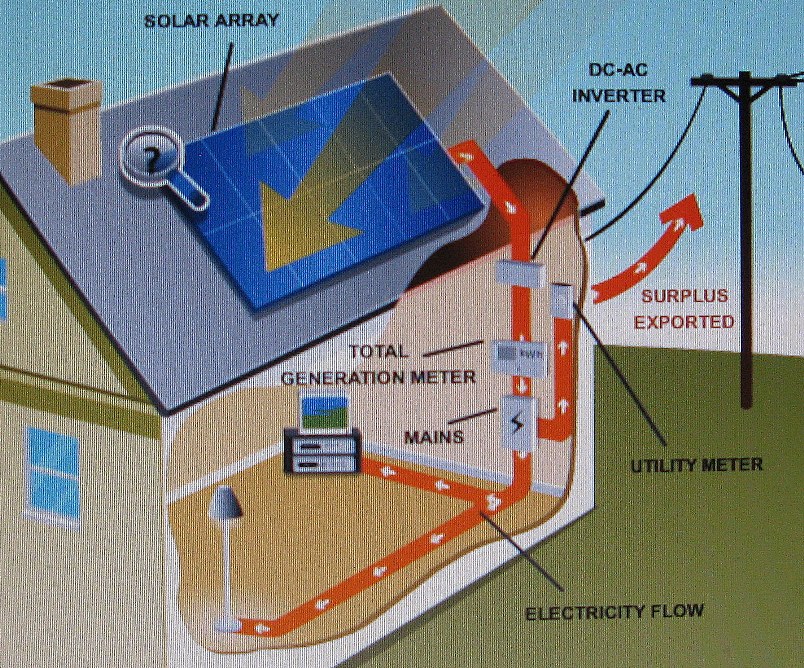
How does it work in practice?
A Company with a certificate installs approved panels or a heat pump for you. A Government-backed contract guarantees you a price, currently 43.3p for every kilowatt hour you generate and 3.1p on top of that for every kilowatt you sell back to the grid. (more…)
Tomorrow – Open Meeting – Renewable Energy
Posted in Memorial hall, Sustainability on Monday July 11, 2011| 3 Comments »
Everyone is invited to the Open Meeting on Community Renewable Energy, tomorrow (Tuesday) at 7.45pm in the Memorial Hall.
The meeting will be lead by John Youatt. Although he will cover the points below, it is a meeting set up to enable our village to find out more about how we can help ourselves with becoming more sustainable – something which becomes ever more relevant as energy prices continue to rise.
1. Formation of Sustainable Youlgrave : why & how
2. Access to grants for feasibility studies for larger communities projects such as Alport hydro scheme, Friden AD plant
3. Help & support for individual projects, eg solar/pv on house roof
4. Government policies, eg Feed-in-Tariffs
5. Planning difficulties
Local business wins Environmental Quality Mark
Posted in Environment, Local Links, News, Peak Park, Sustainability on Saturday June 25, 2011| 1 Comment »
Congratulations to John and Marion F-S, who have been awarded a Peak District Environmental Quality Mark for Tom’s Barn and Douglas’s Barn.
Click here for the full news story, and click here for Marion’s report of the awards ceremony on the Tom’s Barn blog.
Wind Turbine – Reply to Questions Raised
Posted in 2011, Environment, Farming, Planning, Posts of Note, Sustainability on Friday June 17, 2011| 3 Comments »
On Tuesday 17th May Robert Gosling of Hill Top Farm organised an open exhibition regarding his proposals for a wind turbine to be located at his farm. He originally sent a letter into Parwich.org explaining the reasoning behind this plan.
This post is the reply from Robert Gosling to questions raised on Parwich.org and also to questionnaire responses.
1. Can we see the other photomontage locations?
We used a selection which gave a representative view. All
photomontages are below with the map showing the relative
positions.
All photos in this section can be enlarged by clicking on them.
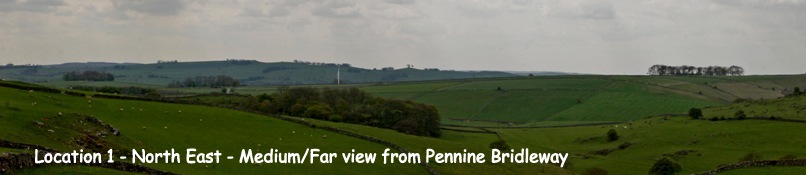
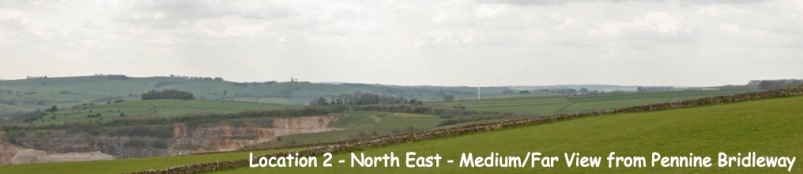
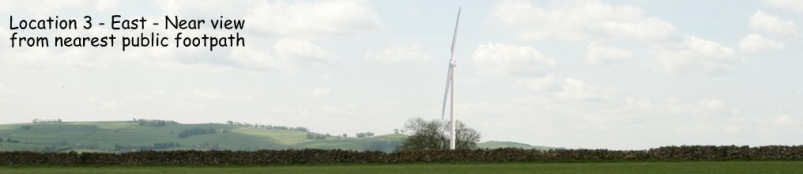
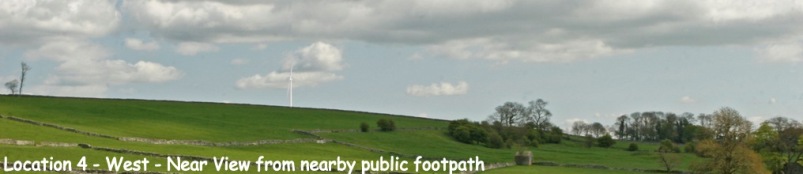
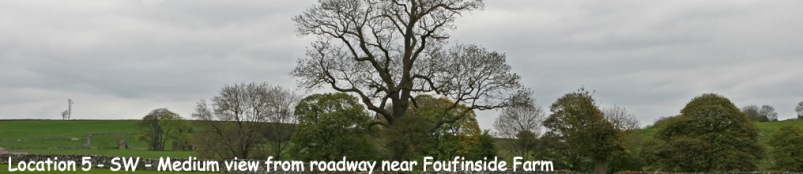
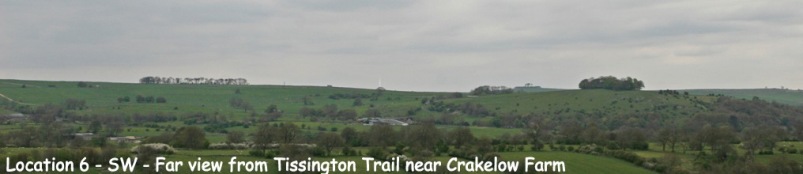
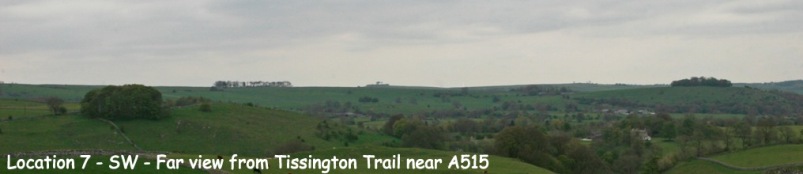
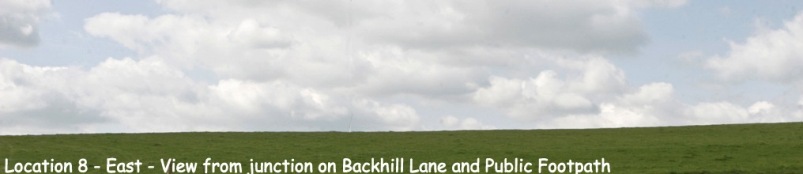
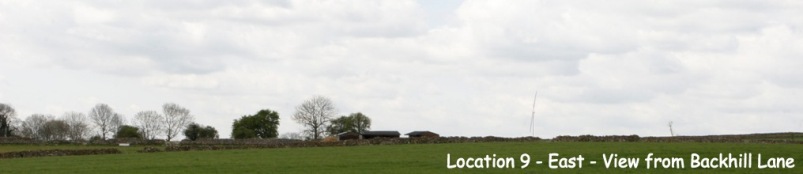
Map showing the location of the photomontages.
Update on proposed Wind Turbines
Posted in Environment, Farming, Planning, Sustainability on Wednesday June 1, 2011| Leave a Comment »
Robert Gosling posted this as a comment.
Many thanks to those of you who attended our display on 17th May, we were very pleased with the discussions and conversations on the night. Many of you have filled in questionnaires and returned them to us. These, along with the posts on the blog have given us a range of questions, comments and suggestions which we will respond to once we have got silaging out of the way. In the meantime please continue to return the questionnaires or leave comments and suggestions on the blog. We will post the results of these by the 17th June on Parwich.org
You can access a copy of this questionnaire, in Word format, by clicking here.
You can either print out a copy and deliver it to Robert Gosling at Hill Top Farm, Parwich (DE6 1QE), or you can save and edit the document, then email it to robert_gosling@btconnect.com.
Proposed wind turbine for Hill Top Farm: exhibition boards & questionnaire
Posted in 2011, Environment, Farming, Planning, Posts of Note, Sustainability on Tuesday May 17, 2011| 1 Comment »
For those who were unable to attend today’s meeting in the Memorial Hall, here are copies of the display boards, in PDF format. These provide detailed information regarding the proposal.
Use left-click to open the files in your browser, or right-click to save copies to your own computer.
Click here for the main set of boards.
Click here for a supplementary board.
Note as that the main set of boards is a large PDF file (7 megabytes), there might be a brief delay in opening it.
Copies of a questionnaire were also distributed at the meeting. You can access a copy of this questionnaire, in Word format, by clicking here.
You can either print out a copy and deliver it to Robert Gosling at Hill Top Farm, Parwich (DE6 1QE), or you can save and edit the document, then email it to robert_gosling@btconnect.com.
Although comments on Robert Gosling’s initial open letter were switched off prior to today’s meeting, there will be no further restrictions, other than the usual guidelines contained in our commenting policy.
PARWICH.ORG will be maintaining a neutral stance on this proposal. Any views expressed by indivdual members of the blog team should not necessarily be taken as representative of the team as a whole.
Proposed wind turbine for Hill Top Farm – Meeting Tomorrow
Posted in Memorial hall, Planning, Sustainability on Monday May 16, 2011| Leave a Comment »
Robert Gosling at Hill Top Farm invites everyone to a meeting tomorrow to discuss the proposal plan which he outlined in an earlier post. Pop into the Memorial Hall anytime between 6pm and 9pm tomorrow, Tuesday 17th May.
Proposed wind turbine for Hill Top Farm
Posted in 2011, Environment, Farming, Planning, Posts of Note, Sustainability on Thursday May 5, 2011| 12 Comments »
We have received the following open letter to all village residents, from Robert Gosling at Hill Top Farm. There will be a meeting, to which you are all invited, to discuss the proposal plan which he outlines below, pop into the Memorial Hall anytime between 6pm and 9pm on Tuesday 17th May.
Dear Resident,
You may be aware of my family farm at Hill Top Farm, either because you know me or a member of my family, or because you have walked or driven past the farm.
My family have in fact farmed in the Peak District for over 100 years, and from Hill Top Farm in particular since 1963. We have one full time and one part time employee to help my family manage a dairy herd of some 400 cows with 400 beef/follower cattle, and we farm approximately 765 acres of land.
The family are extremely interested in the environment. The farm is in the Uplands Entry Level Stewardship Scheme. The farm has also participated in a number of Peak Park Farm and Countryside initiatives for over 20 years (including over 2km of dry stone wall restoration, tree planting, daleside management etc). Linked to the environmental management of the farm, the business is also in a Nitrate Vulnerable Zone and the family have therefore invested in precision slurry application equipment to significantly reduce the use of artificial fertilizer and make better use of the farm’s own natural slurry. (more…)
Contact the blog team
Latest Comments
-


-
-
You can follow @parwichblog on Twitter, and you can also "like" us on Facebook.
-
Recent Posts
 PARWICH.ORG